How to Stop My Lawn Drying Out (UK Guide)

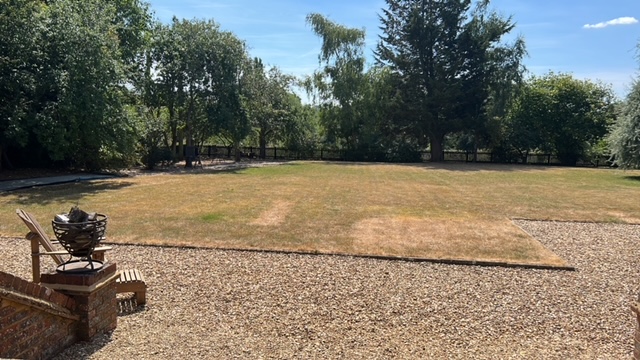
For many UK homeowners, one of the most frustrating sights during summer is a lawn that dries out rapidly — sometimes within just a few days of warm weather. Despite watering, the grass begins to feel brittle underfoot, patches appear, and colour fades from green to straw-like brown.
The important thing to understand is that a drying lawn is not always a watering issue, it’s often a soil physics issue. When soil becomes hydrophobic (water-repellent), water will not soak into the root zone where the grass needs it most. It beads on the surface, runs off, or infiltrates unevenly. As a result, lawns dry out even during rain and irrigation.
This guide explains why lawns dry out, how to stop it, and why wetting agents are the technical solution professionals use in drought and heat stress conditions.
Most UK lawns are composed of cool-season grasses (Perennial Ryegrass, Fescues) which thrive in mild temperatures and consistent moisture. However, during summer or dry spells, these grasses experience:
When moisture drops below a functional level, the root system cannot sustain growth, leading to:
The real trigger point, however, is hydrophobic soil.
As organic matter breaks down and soil dries, waxy organic coatings form around soil particles. This increases surface tension, making water less able to adhere to the soil structure.
The result?
The soil becomes water-repellent.
Symptoms of hydrophobic soil include:
✔ Water sitting on the surface
✔ Water running off quickly
✔ Localised dry patches despite watering
✔ Turf browning in irregular patterns
✔ Green edges where moisture collects
✔ Irrigation being ineffective
The water isn’t the problem — the soil’s absorption is.
A wetting agent is a surfactant (surface-active compound) that reduces surface tension in soil, allowing water to:
Once applied, wetting agents:
This is why wetting agents are standard in golf courses, bowling greens, and sports pitches — environments where drying out is not acceptable.
For domestic lawns, they offer the same benefit on a manageable scale. Here’s a detailed guide on how wetting agents work and why you should use them.
Lawnscience’s wetting agents should be applied three times a year starting in March, watch the video below to learn more.
When the soil repels water, adding more water is pointless.
❌ Doesn’t soak in
❌ Doesn’t reach roots
❌ Doesn’t reduce heat stress
❌ Doesn’t rehydrate dry zones
Instead, it often increases:
Most homeowners don’t realise this and continue watering, unaware that watering without a wetting agent can’t correct hydrophobic soil conditions.
Below is the most effective process for preventing lawn desiccation in the UK.
This is the single most important intervention if your lawn dries out quickly.
Apply wetting agents in:
Once active, wetting agents ensure moisture reaches the roots and stays available, even under high evapotranspiration.
Shallow watering encourages shallow roots, which dry out faster.
Professional turf standard:
Deep watering combined with wetting agents encourages deep root systems, making grass more drought-resistant.
Short grass exposes the soil to direct heat, accelerating drying.
Summer mowing height for UK lawns:
Longer grass shades the soil and protects crowns from heat stress.
Compaction and poor aeration accelerate hydrophobic conditions.
Core aeration in spring allows:
Overseeding with drought-tolerant cultivars (e.g. Fescue blends) further boosts resilience.
Use a fertiliser with:
Avoid harsh, high-salt fertilisers during heat spells — they can dehydrate roots further.
If hydrophobic conditions persist, lawns develop Type I Dry Patch, a condition where grass cannot rehydrate even after rain returns.
Severe dry patch can lead to:
Once the grass dies, only re-turfing or overseeding fixes the damage — prevention via wetting agents is far more cost-effective.
Drying lawns are often accompanied by:
For people who want to:
✔ Stop lawns drying out
✔ Reduce watering bills
✔ Maintain green colour in heat
✔ Prevent patchy summer damage
✔ Improve drought resilience
✔ Avoid autumn renovation costs
Wetting agents are not optional — they are the underlying technical fix that solves the soil-water problem.
A drying lawn is not just suffering from lack of water — it’s often suffering from soil repellency. When the soil becomes hydrophobic, water cannot reach roots, no matter how much you water.
Wetting agents solve this issue at the soil surface tension level, restoring proper moisture infiltration, distribution and retention.
This is why they are used universally in professional turf environments and increasingly recommended for domestic UK lawns. For homeowners who want to stop lawns drying out, wetting agents are the scientifically proven and cost-effective solution.
This usually happens because the soil has become hydrophobic, meaning it repels water. Water sits on the surface instead of reaching the roots. Wetting agents fix this by improving water penetration into the soil.
The most effective solution is applying a lawn wetting agent alongside deep, infrequent watering, higher mowing heights, and appropriate summer feeding.
Yes. Wetting agents are widely used in professional turf management to break down water-repellent soil layers and allow moisture to reach the root zone more evenly.
For UK home lawns, wetting agents are typically applied once in late spring and again mid-summer. Severely dry lawns may benefit from additional applications.
In many cases, dry lawns are dormant rather than dead and will recover once moisture returns. However, prolonged dry conditions without treatment can cause permanent turf loss.
Your Service Guarantee
Our aim at Lawnscience is to be your first choice, local lawn care provider. That is why we select friendly professionals, train them well, and provide a service guarantee.
We also offer our 100% Satisfaction Guarantee with our treatments, If you are not completely satisfied with the results of a treatment, we will re-treat your lawn free of charge. We believe that we are the only UK lawn care provider to offer such a comprehensive guarantee.

Lawnscience supports the RHS through annual charitable donations