Feeding Lawns

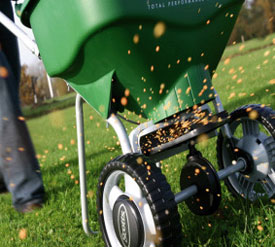
Like all liking organisms lawns require food, feeding should commence March to April when the grass starts to grow, at this time of year your lawn will require a nitrogen rich fertiliser.

Approximately 6-8 weeks later a second feed should be applied to maintain the vigor of the grass. Subsequent fertilisation will depend on your soil type and seasonal conditions. The final fertilisation will be required during autumn, this is important fertilisation as it strengthens and prepares the lawn for the rigors of winter.

The main elements of Lawn fertilisers are nitrogen (N), phosphorus (P) and potassium (K).

Nitrogen is required in larger quantities than phosphorus and potassium as it is an essential component of chlorophyll, amino acids, proteins, nucleic acids, enzymes and other plant substances. Grass normally consists of 3% to 5% nitrogen this being required to ensure healthy plant growth.

Phosphorous is use to hold and transfer energy within the plant for metabolic processes. Highly mobile within the plant phosphorous is conserved and used repeatedly to assist cell production.

Potassium is second only to nitrogen in the amount required to sustain grass growth, it plays an important part in the synthesis of numerous plant compounds and in the regulation of many physiological processes.

Secondary elements such as sulphur, calcium and magnesium are also present in some fertilisers.

Ensuring the correct balance of annual fertilisation program is a skilled job we would be happy to recommend an annual program for your lawn if you require.

Need Help Fertilising Your Lawm

If you would like further advice on lawn fertilisation, just click the orange “Help Please” button below and we’ll contact you.

The RHS is the world's leading gardening charity.

Lawnscience supports the RHS by annual charitable donations

Checkout our latest FREE Guides

Leaf spot disease lawn treatment in 2026: raise mowing height, cut nitrogen, improve drainage, then fungicide if it's spreading. Full step-by-step UK guide.
Anthracnose lawn disease treatment in 2026 means fixing stress first: raise mowing height, correct nitrogen, ease drought, then treat active patches.
Pearlwort resists most lawn weedkillers. See what controls it in 2026 — cultural fixes, aeration, scarification, and when professional treatment is worth it.
Lawn care for canal-side gardens in 2026: fix waterlogging, moss and shade first. Lawnscience's step-by-step plan for narrowboat-adjacent lawns that actually works.
Self-heal weed control in your lawn explained: the herbicide timing, mowing height and feeding fixes that clear it for good, based on 2026 growing conditions.
Best lawn treatment for raised vegetable bed gardens in 2026: Lawnscience's targeted programme wins overall, organic suits chemical-sensitive homes.
Chickweed lawn control in 2026: a selective herbicide plus thicker turf clears it fastest. See what causes it to return and when to get professional help.

Checkout our latest FREE Guides

Leaf spot disease lawn treatment in 2026: raise mowing height, cut nitrogen, improve drainage, then fungicide if it's spreading. Full step-by-step UK guide.
Anthracnose lawn disease treatment in 2026 means fixing stress first: raise mowing height, correct nitrogen, ease drought, then treat active patches.
Pearlwort resists most lawn weedkillers. See what controls it in 2026 — cultural fixes, aeration, scarification, and when professional treatment is worth it.
Lawn care for canal-side gardens in 2026: fix waterlogging, moss and shade first. Lawnscience's step-by-step plan for narrowboat-adjacent lawns that actually works.
Self-heal weed control in your lawn explained: the herbicide timing, mowing height and feeding fixes that clear it for good, based on 2026 growing conditions.
Best lawn treatment for raised vegetable bed gardens in 2026: Lawnscience's targeted programme wins overall, organic suits chemical-sensitive homes.
Chickweed lawn control in 2026: a selective herbicide plus thicker turf clears it fastest. See what causes it to return and when to get professional help.
Request a Call back

Enter your details below to request a call back from us.

    Owning and running my Lawnscience Franchise is the best career move that I have ever made, and I wish I had done it 10 years ago! Nigel Bishop
    These are the questions that our customers ask most frequently.
    What our clients say...
    Felt sure the only remedy for our new house builder's lawn was to rip it up and start again! Lawnscience showed us other potential less drastic options and has made them a reality. Glad we consulted Lawnscience then, and very happy to continue to use…
    Mr Kenward
    What our clients say...
    Really friendly and knowledgeable team. My lawn was full of moss and weeds. Now It looks like a lawn should do. Green, lush and healthy.
    Trevor Dealey
    What our clients say...
    Lawnscience are always prompt and helped me keep on top of treatments for a newly laid lawn. Certainly takes the hassle away of burning grass etc when trying to add treatments yourself. Very good value for money. Nice guy.
    Mr Hamilton
    What our clients say...
    1st class service. Very knowledgeable on lawn care and how to improve our garden. Provided a course of action and a timetable to work to keep expectations high. Grass scarified and reseeded with great results
    Mr Murray
    What our clients say...
    Lawnscience provide a service of feeding the grass and killing the weeds and moss that are in all lawns. The treatment varies depending on the time of year. By using Lawnscience a minimum of four times a year our lawns have shown a vast improvement.
    Mr Knight
    Lady assesses lawn
    Request a Call back

    Enter your details below to request a call back from us.