Lawn Care for Gardens With Cat Runs (2026 Guide)

Gardens with outdoor cat runs need lawn care that targets compacted patrol tracks, urine scorch near fence lines, and shade under run canopies, with the aim of a lawn that stays green and walkable under constant supervised access. Unlike a dog run, where wear spreads across a wider loop, cats tend to pace a narrow fixed strip along the mesh and favour the same corner for toileting, so damage concentrates instead of spreading out.

TL;DR
  • Lawn care for gardens with cat runs works best when aeration, urine-scorch repair and shade-tolerant seed are treated as one plan, not three separate jobs.
  • Cats wear a narrow 30-40cm strip along the run mesh rather than a wide loop, so compaction and bare soil concentrate in one line.
  • Nitrogen scorch from a favourite corner shows as a yellow ring within 24-48 hours and needs watering-in, not more feed.
  • A shade-tolerant, fine-leaved seed mix under run canopies outlasts standard ryegrass blends by several seasons.
  • Professional treatment on a 6-8 week cycle catches compaction and scorch before they turn into bare patches.

Why lawn care matters for gardens with cat runs

A cat run changes how a lawn wears in ways a standard family garden doesn't. The animal's fixed patrol line along the fence creates a repeat-pressure strip rather than the diffuse wear you'd get from a dog covering the whole garden, and that strip compacts the soil until roots can't get oxygen or water down to them.

Run structures also throw shade and rain-shadow across part of the lawn, whether from mesh roofing, a lean-to catio, or a covered walkway section. Grass under that shade thins first, and once it thins, weeds and moss move in faster than they would in open lawn. The pattern is close to what shows up in dog run gardens, except the wear line is narrower and the urine spots are more concentrated because cats return to the same corner rather than marking widely.

Build a lawn care routine for cat run gardens

Map the wear pattern before you treat

Walk the run at different times of day and note where the grass is thinnest, where the soil feels hard underfoot, and where any yellow rings sit. This map tells you where to focus aeration and seed rather than treating the whole lawn the same way.

  • Mark the patrol strip along the fence line with canes or spray paint
  • Note corners where the cat consistently toilets
  • Check soil hardness by pushing a screwdriver into the ground at 5-6 points
  • Photograph the run monthly so you can track whether patches are spreading

Aerate the compacted patrol strip

The narrow wear line under a cat run compacts faster than open lawn because the same few centimetres take repeated pressure. Hollow-tine aeration opens that soil back up so water, air and feed can reach the roots instead of running off the surface.

  • Aerate the patrol strip and run entrance separately from the rest of the lawn if compaction is localised
  • Use a hollow-tine fork or hire a machine for runs over a few metres long
  • Top-dress with sandy loam after aerating to keep the holes open longer
  • Time it for spring or early autumn when the grass can recover before extreme heat or frost

If the compacted strip keeps closing back up within a season, a professional aeration and feed programme diagnoses whether it's soil type or root depth causing the repeat failure, rather than you guessing at it every few months.

Flush and treat urine scorch spots

A favourite toileting corner shows nitrogen scorch as a yellow ring, often visible within 24-48 hours of a fresh patch appearing. The centre can die back to bare soil while a darker green halo forms around the edge from the extra nitrogen.

  • Water the spot heavily within a few hours of noticing fresh scorch to dilute the nitrogen
  • Avoid extra fertiliser on scorch rings until the grass recovers
  • Reseed bare centres once the soil has been flushed and cooled
  • Consider a low-fence deterrent or a second toileting area to spread the load

Overseed with a shade and traffic-tolerant mix

Standard ryegrass lawn seed struggles under run canopies where light is reduced and foot traffic (paw traffic) is constant. A finer-leaved, shade-tolerant mix holds density better in these conditions and recovers faster after scorch.

  • Choose a mix with fescue content for shade tolerance under mesh roofing
  • Overseed in spring or early autumn rather than midsummer
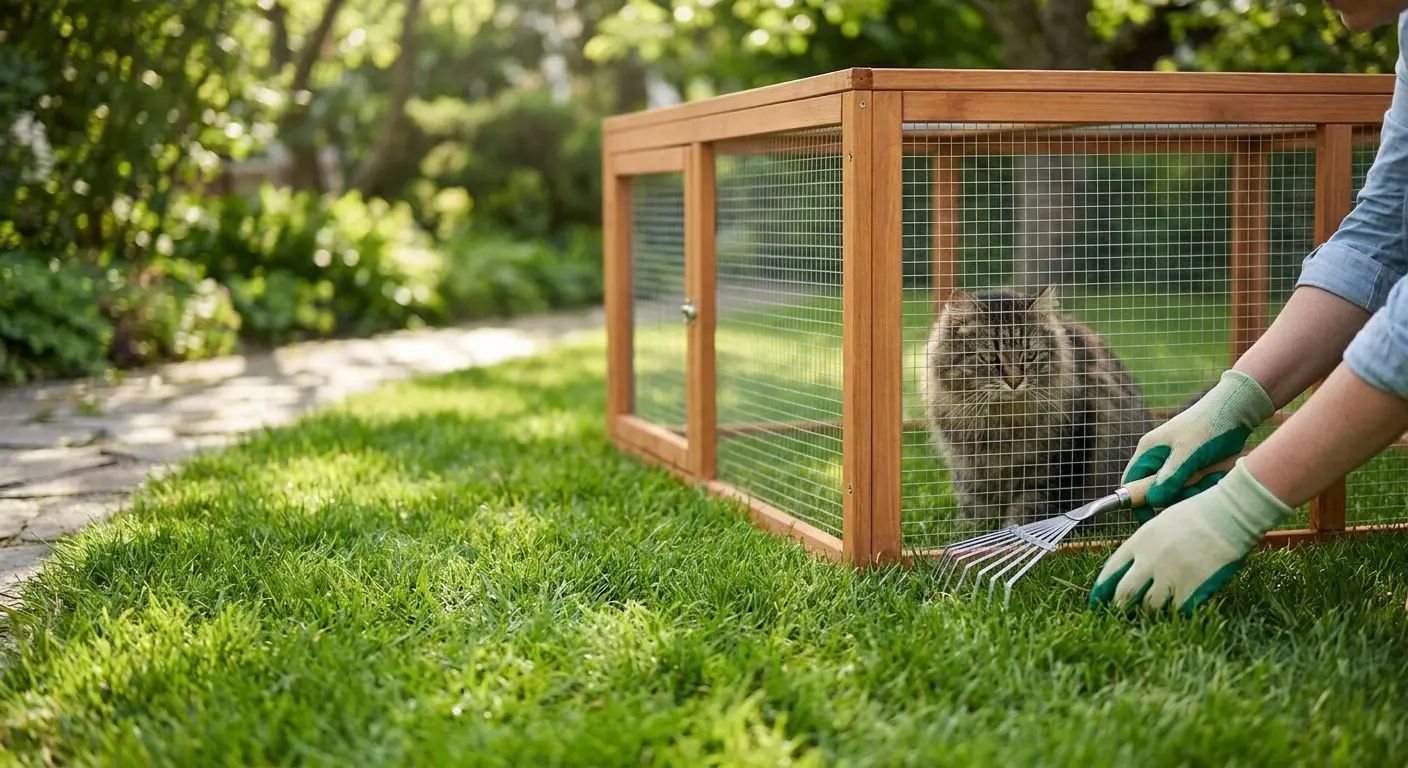
  • Rake lightly to expose soil before scattering seed so it makes contact
  • Keep the area damp for the first two to three weeks after sowing

A shaded lawn overseeding approach applies directly here, since a cat run canopy creates the same reduced-light problem as a tree or fence shadow.

Adjust mowing height for run corridors

Cutting the patrol strip too short adds more stress on top of the compaction and traffic it already takes. Raising the blade height on that section helps the grass hold on to more leaf area to photosynthesise and recover.

  • Set mowing height to roughly 35-40mm on wear strips rather than a tighter cut
  • Mow the run corridor less frequently than open lawn if growth is already thin
  • Remove clippings from scorch zones so they don't add extra nitrogen on top of urine
  • Sharpen blades regularly, since a ragged cut stresses already-thin grass further

Control weeds along the fence line without harming the cat

Weeds move fastest into the thin, compacted strip under and around the run mesh, but any treatment there needs to be safe for an animal that's out on the lawn daily. Pet-friendly weed control products and timed re-entry are the safer route rather than a generic garden weedkiller applied without a plan.

  • Spot-treat weeds along the fence line rather than blanket-spraying the whole lawn
  • Keep the cat off the treated section for the re-entry period stated on the product
  • Hand-pull persistent weeds like plantain or daisies in the run itself where spray drift is a concern
  • Reseed any bare ground left after weed removal so it doesn't sit open for moss to colonise

Set a repeat treatment plan

A cat run lawn under constant, concentrated pressure recovers better with a scheduled plan than with one-off fixes chased after the damage shows. Most professional lawn treatment programmes work on roughly a 6-8 week cycle through the growing season, timed around feed, weed control and seasonal aeration.

  • Book aeration for spring and autumn rather than waiting until compaction is severe
  • Time feed applications to support recovery after each overseed
  • Reassess the run map every few months to see if the wear pattern has shifted
  • Adjust the plan if the cat's favourite spots change after furniture or run layout moves

Comparing your options for a cat run lawn

Option Best for Key limitation
DIY spot repair (seed, water, patience) Small, single scorch patches Slow, and compaction under the run rarely gets fixed
Professional lawn treatment programme Ongoing wear along a fixed patrol strip Needs a booked schedule rather than one-off calls
Full turf replacement under the run Severely compacted or bare runs beyond repair Higher disruption, and the same wear pattern returns without changed use
Artificial turf inside the run only Runs with almost no light reaching the ground No living root system, so it won't extend to the rest of the lawn

A professional lawn treatment programme wins for gardens where the cat run wear strip keeps failing year after year, because it treats aeration, feed and seed as one cycle instead of chasing each symptom separately.

Common mistakes in cat run gardens

  • Feeding scorch patches instead of watering them — extra nitrogen on top of urine nitrogen makes the die-back worse, not better.
  • Using a standard sun-mix seed under a covered run — it thins out again within a season because it can't handle the reduced light.
  • Treating the whole lawn the same as the patrol strip — the wear strip needs more frequent attention than the open lawn around it.
  • Applying weedkiller without checking re-entry timing — the cat is out on that lawn daily, so pet reentry timing matters more here than in a garden with occasional pet access.
  • Ignoring the run entrance gate area — repeated pausing at the gate compacts that spot faster than anywhere else in the run.

Get a lawn plan built for cat runs

Local treatment for compacted strips, scorch patches and shaded run corners.

FAQ

What’s the best lawn care for gardens with cat runs?

The best approach combines aeration on the compacted patrol strip, urine-scorch flushing at favourite corners, and a shade-tolerant seed mix under any covered section. Treating these as one repeat plan works better than fixing each patch as it appears.

Is professional lawn treatment better than DIY for a cat run?

Professional treatment works better where the wear strip keeps failing every season, since it schedules aeration, feed and seed together. DIY spot repair is fine for a single scorch patch but rarely fixes underlying compaction.

How much lawn treatment does a cat run garden need in 2026?

Most gardens with a cat run need the same core programme as any lawn plus extra aeration passes on the patrol strip, typically fitted into a 6-8 week treatment cycle through the growing season in 2026.

Why does grass die in a straight line under a cat run?

Cats pace the same fixed strip along the fence rather than covering the whole run, so pressure and compaction concentrate in one narrow line instead of spreading out.

Can I use normal weedkiller in a garden with an outdoor cat run?

Use a pet-friendly weed control product and respect the stated re-entry period rather than a generic weedkiller, since the cat is out on that lawn daily.

What grass seed works best under a covered cat run?

A fine-leaved, shade-tolerant mix with fescue content holds density better under mesh roofing or a catio cover than a standard sun-blend ryegrass seed.

How long does urine scorch take to show on a lawn?

Fresh urine scorch typically shows as a yellow ring within 24-48 hours, with the centre browning off if the nitrogen concentration is high enough.

Should I mow a cat run patrol strip the same as the rest of the lawn?

No, raise the mowing height to roughly 35-40mm on the wear strip so the grass keeps more leaf area to recover, rather than cutting it as short as open lawn.

One last thing

The detail owners miss most in 2026 is the run entrance gate, not the patrol strip itself. Cats pause there to check the garden before heading out, and that repeated stop-start pressure compacts the gate area faster than the long straight stretch of fence beside it, so check it separately when you're mapping wear.

Related guides

Checkout our latest FREE Guides

Lawn care for gardens with heavy leaf fall in 2026: clearing schedules, mowing timing and disease checks that stop leaf litter from wrecking your grass.
Lawn care for gardens with cat runs in 2026: fix compacted patrol strips, urine scorch and shaded patches with a proven treatment plan from Lawnscience.
How to repair tyre tracks in lawn: level, aerate, topdress and overseed. Shallow ruts heal in weeks; deep ruts need soil rebuilt first. Full 2026 steps inside.
Lawn care for gardens backing onto woodland in 2026: fix shade, moss, leaf litter and wildlife damage with the right seed, feed and treatment schedule.
Lawn care for gardens with fruit trees in 2026: feed, aerate and overseed the shaded root zone right with Lawnscience's step-by-step orchard lawn plan.
Best lawn treatment for outdoor fitness class gardens in 2026: aeration, overseeding and a full programme ranked with pros, cons and verdicts.
The best lawn treatment for dog boarding kennels in 2026 pairs a dedicated dog-run programme with urine patch fixes and safe reentry scheduling.

Checkout our latest FREE Guides

Lawn care for gardens with heavy leaf fall in 2026: clearing schedules, mowing timing and disease checks that stop leaf litter from wrecking your grass.
Lawn care for gardens with cat runs in 2026: fix compacted patrol strips, urine scorch and shaded patches with a proven treatment plan from Lawnscience.
How to repair tyre tracks in lawn: level, aerate, topdress and overseed. Shallow ruts heal in weeks; deep ruts need soil rebuilt first. Full 2026 steps inside.
Lawn care for gardens backing onto woodland in 2026: fix shade, moss, leaf litter and wildlife damage with the right seed, feed and treatment schedule.
Lawn care for gardens with fruit trees in 2026: feed, aerate and overseed the shaded root zone right with Lawnscience's step-by-step orchard lawn plan.
Best lawn treatment for outdoor fitness class gardens in 2026: aeration, overseeding and a full programme ranked with pros, cons and verdicts.
The best lawn treatment for dog boarding kennels in 2026 pairs a dedicated dog-run programme with urine patch fixes and safe reentry scheduling.
Request a Call back

Enter your details below to request a call back from us.

    Owning and running my Lawnscience Franchise is the best career move that I have ever made, and I wish I had done it 10 years ago! Nigel Bishop
    These are the questions that our customers ask most frequently.
    What our clients say...
    Felt sure the only remedy for our new house builder's lawn was to rip it up and start again! Lawnscience showed us other potential less drastic options and has made them a reality. Glad we consulted Lawnscience then, and very happy to continue to use…
    Mr Kenward
    What our clients say...
    Really friendly and knowledgeable team. My lawn was full of moss and weeds. Now It looks like a lawn should do. Green, lush and healthy.
    Trevor Dealey
    What our clients say...
    Lawnscience are always prompt and helped me keep on top of treatments for a newly laid lawn. Certainly takes the hassle away of burning grass etc when trying to add treatments yourself. Very good value for money. Nice guy.
    Mr Hamilton
    What our clients say...
    1st class service. Very knowledgeable on lawn care and how to improve our garden. Provided a course of action and a timetable to work to keep expectations high. Grass scarified and reseeded with great results
    Mr Murray
    What our clients say...
    Lawnscience provide a service of feeding the grass and killing the weeds and moss that are in all lawns. The treatment varies depending on the time of year. By using Lawnscience a minimum of four times a year our lawns have shown a vast improvement.
    Mr Knight
    Lady assesses lawn
    Request a Call back

    Enter your details below to request a call back from us.